Clothing Coventry’s Safeguarding Policy for Children and Vulnerable Adults
- Introduction
This Safeguarding Policy has been prepared in accordance with legislation, statutory guidance and national/local safeguarding procedures regarding the needs of vulnerable adults and children. (In Particular Working Together to Safeguard Children: A guide to inter-agency working to safeguard and protect the welfare of children. 2019)
Every child or adult can be hurt, put at risk of harm or abused in other ways. The actions we must take to promote their welfare, and protect them from harm, are the responsibility of us all. Everyone who comes into contact with adults at risk, pregnant women, or children has a role to play.
‘Looking the other way’ is not an option. Adopting and putting this policy into practice is essential for all involved with Clothing Coventry at every level.
Effective safeguarding of children can only be achieved by putting children at the centre of the system, and by every individual and agency playing their full part, working together to meet the needs of our most vulnerable children.
Clothing Coventry is committed to the following principles at all times when safeguarding children:
All children have the right to be protected from harm;
The best interests of children will always continue to come first;
All staff are responsible for keeping children safe and have a responsibility to act if they think a child is at risk of harm;
If anyone has a safeguarding concern about any child they should continue to follow usual procedures and must act and act immediately;
A Designated Safeguarding Officer should be available; and
Working with other agencies (such as Children’s Services) is essential to promote safeguarding and protect children from harm.
- Purpose and scope of this policy
The purpose of this policy is to set out the expectations placed on those working and volunteering with Clothing Coventry, and to provide information that promotes the safeguarding of all children and adults.
This policy applies to all of our activities.
- Definition of terms
This document uses the following definition of terms:
- Child - anyone under the age of 18 years.
- Vulnerable adult - a person aged 18 years or over who is experiencing or at risk of abuse (including neglect).
- Abuse - the violation of an individual’s human and civil rights by any other person or persons. This includes physical abuse, emotional/psychological abuse, financial or material abuse, sexual abuse, neglect and acts of omission.
- For a child Clothing Coventry refer to the 4 main types of abuse:
- Physical abuse is deliberately physically hurting a child. It might take a variety of different forms, including hitting, pinching, shaking, throwing, poisoning, burning or scalding, drowning or suffocating a child. Physical harm may also be caused when a parent or carer fabricates the symptoms of, or deliberately induces, illness in a child. Physical abuse can also occur outside of the family environment. Female Genital Mutilation should be considered here.
- Emotional abuse – Emotional abuse is the persistent emotional maltreatment of a child. Emotional abuse may involve deliberately telling a child that they are worthless, or unloved and inadequate. It may include not giving a child opportunity to express their views, deliberately silencing them or ‘making fun’ of what they say or how they communicate. Emotional abuse may involve serious bullying – including online bullying through social networks, online games or mobile phones – by a child’s peers.
- Sexual abuse is any sexual activity with a child. Sexual abuse may involve physical contact, including assault by penetration (for example, rape or oral sex) or non-penetrative acts such as masturbation, kissing, rubbing and touching outside clothing. It may include non-contact activities, such as involving children in the production of sexual images, forcing children to look at sexual images or watch sexual activities, encouraging children to behave in sexually inappropriate ways or grooming a child in preparation for abuse (including via the internet). Sexual abuse is not solely perpetrated by adult males. Women can commit acts of sexual abuse, as can other children. Child sexual exploitation should also be considered here.
- Neglect is a pattern of failing to provide for a child’s basic needs, whether it be adequate food, clothing, hygiene, supervision or shelter. Neglect may occur if a parent becomes physically or mentally unable to care for a child. A parent may also have an addiction to alcohol or drugs, which could impair their ability to keep a child safe or result in them prioritising buying drugs, or alcohol, over food, clothing or warmth for the child. Neglect may occur during pregnancy as a result of maternal drug or alcohol abuse.
- Please note we have referred to government guidance for our definitions: https://assets.publishing.service.gov.uk/government/uploads/system/uploads/attachment_data/file/419604/What_to_do_if_you_re_worried_a_child_is_being_abused.pdf
- We use the following terms for vulnerable adults
- Physical Abuse includes assault, hitting, slapping, pushing, kicking, misuse of medication, being locked in a room, inappropriate sanctions or force-feeding, inappropriate methods of restraint, and unlawfully depriving a person of their liberty.
- Domestic violence is defined as any incident or pattern of incidents of controlling, coercive, threatening behaviour, violence or abuse between those aged 16 or over who are, or have been, intimate partners or family members regardless of gender or sexuality. The abuse can encompass, but is not limited to: psychological, physical, sexual, financial, and emotional. This can include such things as forced marriage, honour-based violence and Female Genital Mutilation
- Sexual abuse including rape, indecent exposure, sexual harassment, inappropriate looking or touching, sexual teasing or innuendo, sexual photography, subjection to pornography or witnessing sexual acts, indecent exposure and sexual assault or sexual acts to which the adult has not consented or was pressured into consenting. It includes penetration of any sort, incest and situations where the person causing harm touches the abused person’s body (e.g. breasts, buttocks, genital area), exposes his or her genitals (possibly encouraging the abused person to touch them) or coerces the abused person into participating in or looking at pornographic videos or photographs. Denial of a sexual life to consenting adults is also considered abusive practice.
- Psychological abuse includes ‘emotional abuse’ and takes the form of threats of harm or abandonment, deprivation of contact, humiliation, rejection, blaming, controlling, intimidation, coercion, indifference, harassment, verbal abuse (including shouting or swearing), cyber bullying, isolation or withdrawal from services or support networks.
- Financial abuse includes theft, fraud, internet scamming, coercion in relation to an adult’s financial affairs or arrangements, including in connection with wills, property, inheritance or financial transactions, or the misuse or misappropriation of property, possessions or benefits.
- Modern Slavery encompasses slavery, human trafficking, forced and compulsory labour and domestic servitude. Traffickers and slave masters use whatever means they have at their disposal to coerce, deceive and force individuals into a life of abuse, servitude and inhumane treatment.
- Discriminatory abuse includes discrimination on the grounds of race, faith or religion, age, disability, gender, sexual orientation and political views, along with racist, sexist, homophobic or ageist comments or jokes, or comments and jokes based on a person’s disability or any other form of harassment, slur or similar treatment.
- Organisational Abuse Including neglect and poor care practice within an institution or specific care setting such as a hospital or care home, or where care is provided within their own home.
- Neglect and Acts of Omission include ignoring medical, emotional or physical care needs, failure to provide access to appropriate health, social care or educational services, and the withholding of the necessities of life such as medication, adequate nutrition and heating. Neglect also includes a failure to intervene in situations that are dangerous to the person concerned or to others, particularly when the person lacks the mental capacity to assess risk for themselves
- Self-neglect covers a wide range of behaviour, neglecting to care for one’s personal hygiene; health or surroundings and can include behaviour such as hoarding.
- Please note we have referred to Warwickshire Safeguarding adults for definitions: https://www.safeguardingwarwickshire.co.uk/safeguarding-adults/i-work-with-adults/recognising-and-reporting-abuse
- Our commitments
At Clothing Coventry we are committed to protect and care for everyone involved with the charity, but especially adults at risk and children.
4.1. We are committed to:
- The care of, the nurture of, and respectful relationships with all children and adults.
- The safeguarding and protection of all children and adults.
- The establishing of a safe, caring community which provides a loving environment where victims of abuse can report or disclose abuse and where they can find support and best practice that contributes to the prevention of abuse.
4.2. To this end we will:
- Carefully select, support and train all those working in a paid or unpaid capacity with Clothing Coventry.
- Respond without delay to every complaint made that a child or adult may have been harmed, cooperating with the police and local authority in any investigation.
- Seek to offer support to anyone who has suffered abuse, recognising the importance of understanding the needs of those who have been abused, including their feelings of alienation and/or isolation.
- Seek to protect survivors of abuse from the possibility of further harm and abuse.
- Seek to challenge any abuse of power, especially by anyone in a position of respect and responsibility, where they are trusted by others.
4.3. In all of the above:
- We will follow legislation, guidance and recognised good practice.
- We will monitor and regularly review our safeguarding procedures.
- Training and advice
Clothing Coventry will provide appropriate safeguarding training for all Trustees, paid staff and volunteers who work with adults at risk or children. The aim of such training is to equip people with the skills and knowledge needed to ensure effective safeguarding.
Where an issue is raised where additional advice is required this will be available from the Local Safeguarding Board on 024 7683 2568.
- DBS checks
All Trustees and paid staff will be required to have a DBS check. Volunteers in the following categories will also be required to have a DBS check:
Those working one-to-one in the homes, involved in home-visiting; and volunteers working directly with children. Refresh every three years.
- Clothing Coventry’s Safeguarding Officer
Working under the authority of the Trustees, the Safeguarding Officer takes the lead role for safeguarding within the charity’s activities.
The Safeguarding Officer will:
- Be the first port of call for any safeguarding issues for families, volunteers and staff.
- Decide next steps and actions based upon information shared by Clothing Coventry families, volunteers and staff which suggest there may be a safeguarding concern. This may mean taking up any safeguarding issues with the relevant authorities, such as children services, adult social care or the police.
- Be the main person responsible for liaising with outside agencies with the purpose of safeguarding.
- Ensure that safeguarding information is up to date, accurate and stored securely.
- Be available to offer support and guidance to staff and volunteers
- Update their knowledge and skills regularly and keep up with any developments relevant to their role;
- Monitor the progress of any safeguarding issues passed to another authority, where the person at risk is still in contact with Clothing Coventry.
- Ensure that DBS checks are done and then receive notifications regarding online DBS checks.
- Ensure that Safeguarding Training is provided on all volunteer training programmes; and that training opportunities are brought to the attention of all staff and Trustees.
- Ensure that the Trustees are updated with any safeguarding actions taken.
Contact details:
Name: David Wilson Phone: 07804746459 Email: david@clothingcoventry.org
- Managing safeguarding situations
The Safeguarding Officer and the Trustees are together responsible for ensuring that safeguarding policies and procedures are implemented within Clothing Coventry.
If a child is at risk of harm, a referral should be made to the Multi-Agency Safeguarding Hub (MASH) without delay. The safeguarding officer should be available to support and manage this. If the safeguarding officer is not available, another member of the leadership team may be available, should this not be the case- any one is able to make a referral to the police or children’s social care to seek advice and support.
All staff and volunteers undertaking tasks on behalf of Clothing Coventry are expected to follow the safeguarding procedures in addition to the below:
▪ Alerting the safeguarding officer to any signs and indicators that there could be a risk of harm to a family/child. Even if you think the issue is minor, the safeguarding officer may have more information that, together with what you know, represents a more serious worry. It is always your responsibility to share concerns, no matter how small.
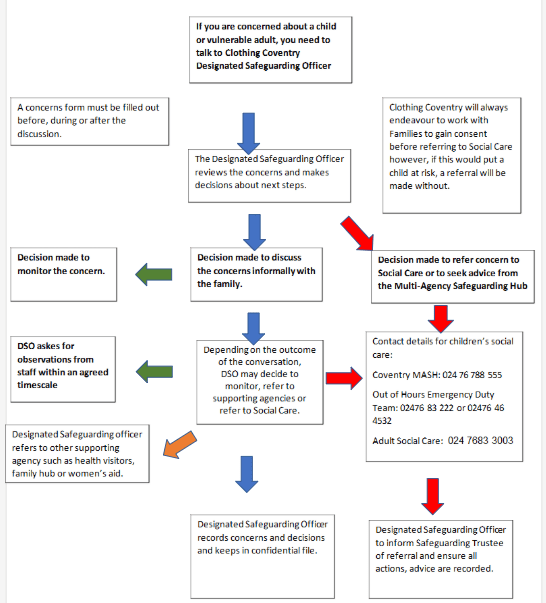
▪ Recording concerns and any following actions in a safe and secure manner. Should there need to be access to these records, the Designated Safeguarding officer will have access, should you not be able to contact the safeguarding officer – please contact the CEO. All files should be and remain confidential to the safeguarding team and should not be shared unless absolutely necessary. Please see Appendix A.
Know what to do if a child or adult tells them that he/she is being abused or neglected;
Will be able to identify indicators of abuse;
Will be made aware of; the safeguarding policy;
Should have an awareness of safeguarding issues that put children and adults at risk of harm and behaviours associated with these risks;
Should know what to do if a child makes a disclosure of abuse and never promise confidentiality should a child makes a disclosure;
Will receive regularly updated safeguarding and child protection training.
There will be occasions where a child discloses abuse directly to a member of staff. If this happens, the member of staff will;
Listen carefully to the child and believe what they are saying; not promise confidentiality, as information may need to be passed on so the child and family can receive additional support; only ask for clarification if something is unclear and will not ask ‘leading’ questions; report disclosure to the designated safeguarding lead as soon as possible, certainly by the end of the day; only discuss the issue with colleagues that need to know about it; and will write up the disclosure and pass it to the Safeguarding Officer. It is likely they will have a discussion with the Safeguarding Officer prior to this.
The safeguarding officer will make a decision about the action that needs to be taken following a member of staff raising a concern about a child, or following a direct disclosure. The Safeguarding officer may; Manage support for the child internally; Seek advice from the MASH; Refer or signpost to other relevant agencies, such as the health visiting team.
In cases where children are deemed to be at significant risk of harm, the Safeguarding officer will refer cases to the MASH for statutory intervention. Parental consent will be obtained wherever possible before referring cases to the MASH. However, if Clothing Coventry is worried that telling parents will mean the child is at greater risk of harm, we may do this without informing them. If parents do not consent to a referral but the Clothing Coventry believes that a child is at significant risk of harm, a referral will still be made to children’s social care.
Should concerns be raised regarding a vulnerable adult; the safeguarding officer will, with the consent of the adult signpost and refer to relevant agencies who can offer safeguards and support. The adult safeguarding team can be contacted to seek advice and guidance.
- How do I contact someone if I am concerned about a child or young person at risk?
- If you wish to report a matter to the police, call 101 and state your concerns.
- If you wish to report an emergency matter always dial 999.
- If there is no immediate danger or you need advice or information, you should call the Initial Contact Team at the Multi Agency Safeguarding Hub (MASH)– Tel: 024 7678 8555, the emergency duty team for out of hours social work is: 024 7683 2222.
- Trustees’ responsibilities
The trustees must:
- Formally adopt this policy and file a copy with the Board’s minutes.
- Display a Safeguarding Statement and a Child friendly Poster telling the children who it is safe to share concerns with in every venue used.
- Appoint a Safeguarding Officer and ensure that this role is always filled.
- Safeguarding Officer: Katie Wilson
- Appoint a Trustee with overall responsibility for Safeguarding:
Trustee for Safeguarding: David Wilson
The safeguarding officer will update the Trustee of any safeguarding issues regarding the day to day running of Clothing Coventry activities. The safeguarding officer is to take the lead in making referrals, completing actions, liaising with safeguarding agencies and act in a timely manner. The safeguarding officer will keep the trustee for safeguarding updated on any actions that have needed to take place.
The Trustee for safeguarding will endeavour to be available for guidance and advice, however, if someone is at risk there should be no delay, the safeguarding officer must contact the necessary agencies in order to keep Clothing Coventry families safe.
- Ensure that all activities involving children, or adults at risk:
- Have appropriate insurance cover;
- Have an Activity Plan and Risk Assessment which is reviewed at least once a year;
- Are supported by a nominated First Aider.
- Comply with Data Protection Principles – specifically with reference to storing information about the workforce, including volunteers who have completed a confidential declaration and/or undergone DBS checks.
- Receive and discuss an annual Safeguarding Report from the Safeguarding Officer.
- Ensure that all those authorised to work with children, or adults at risk, are:
(i) Recruited in accordance with safe recruitment procedures, including DBS checks;
(ii)Adequately supported and have access to all relevant policies and safeguarding resources;
(iii) Trained appropriately for their roles (including relevant safeguarding training).
(iv) Aware that they should not be emailing children and young people, in line with the E-Safety Policy.
- Review the implementation of this policy annually.
Appendix A
The seven golden rules to sharing information
1. Remember that the Data Protection Act 1998 and Human Rights law are not barriers to justified information sharing, but provide a framework to ensure that personal information about living individuals is shared appropriately.
2. Be open and honest with the individual (and/or their family where appropriate) from the outset about why, what, how and with whom information will, or could be shared, and seek their agreement, unless it is unsafe or inappropriate to do so.
3. Seek advice from other practitioners if you are in any doubt about sharing the information concerned, without disclosing the identity of the individual where possible.
4. Share with informed consent where appropriate and, where possible, respect the wishes of those who do not consent to share confidential information. You may still share information without consent if, in your judgement, there is good reason to do so, such as where safety may be at risk. You will need to base your judgement on the facts of the case. When you are sharing or requesting personal information from someone, be certain of the basis upon which you are doing so. Where you have consent, be mindful that an individual might not expect information to be shared.
5. Consider safety and well-being: Base your information sharing decisions on considerations of the safety and well-being of the individual and others who may be affected by their actions
6. Necessary, proportionate, relevant, adequate, accurate, timely and secure: Ensure that the information you share is necessary for the purpose for which you are sharing it, is shared only with those individuals who need to have it, is accurate and up-to-date, is shared in a timely fashion, and is shared securely (see principles).
7. Keep a record of your decision and the reasons for it – whether it is to share information or not. If you decide to share, then record what you have shared, with whom and for what purpose.
When and how to share information
When asked to share information, you should consider the following questions to help you decide if and when to share. If the decision is taken to share, you should consider how best to effectively share the information.
When
Is there a clear and legitimate purpose for sharing information? • Yes – see next question • No – do not share
Does the information enable an individual to be identified? • Yes – see next question • No – you can share but should consider how
Is the information confidential? • Yes – see next question • No – you can share but should consider how
Do you have consent? • Yes – you can share but should consider how • No – see next question
Is there another reason to share information such as to fulfil a public function or to protect the vital interests of the information subject? • Yes – you can share but should consider how • No – do not share
How
• Identify how much information to share
• Distinguish fact from opinion
• Ensure that you are giving the right information to the right individual • Ensure where possible that you are sharing the information securely
• Inform the individual that the information has been shared if they were not aware of this, as long as this would not create or increase risk of harm
All information sharing decisions and reasons must be recorded in line with your organisation or local procedures. If at any stage you are unsure about how or when to share information, you should seek advice and ensure that the outcome of the discussion is recorded. If there are concerns that a child is suffering or likely to suffer harm, then follow the relevant procedures without delay.
Appendix B
REPORTING YOUR CONCERNS ABOUT A CHILD OR VULNERABLE ADULT’S SAFETY AND WELFARE
| Name of young person/vulnerable adult: | Date of birth |
| Date of completing the form: | Time of completing the form. |
| Your name: | Your position: |
| Your signature: | Your organisation: |
| Reason for recording incident: | |
| Please note the action taken, including the names of anyone to whom information was passed. 1. 2. 3. | |
Appendix C
Important Contact Numbers
| Initial contact Multi-Agency Safeguarding Team (Mash) | Email: mash@coventry.gov.uk Tel: 024 7683 2568 Address: 4th Floor, Broadgate House Coventry CV1 5RS |
| MASH Emergency Duty Team (Out of Hours) | 024 7683 2222 or 024 7646 4532 |
| Independent Reviewing Officers | 024 7683 2568 |
| Adult Social Care Team | 024 7683 3003 |
| FGM Helpline | 0800 028 3550 |
| Horizon Team (Child Sexual Exploitation) | To report any CSE concerns, call the police on 101 or 999 in an emergency or Coventry Social Care on 024 7678 8555 or out of hours on 024 7683 2222 |
| CDVASS (Domestic Violence) | 0800 035 5309 |
| All Age Disability Team | 024 7678 7980 |
Appendix D
Safeguarding Flowchart for Clothing Coventry
 Clothing Coventry